At a glance
In this single-center validation study, single-step warming improved post-warming blastocyst survival, intactness, and transfer-related measures versus conventional multi-step warming. Ongoing pregnancy rates were comparable, while miscarriage rates were numerically lower with single-step warming across all subgroups.¹
The study
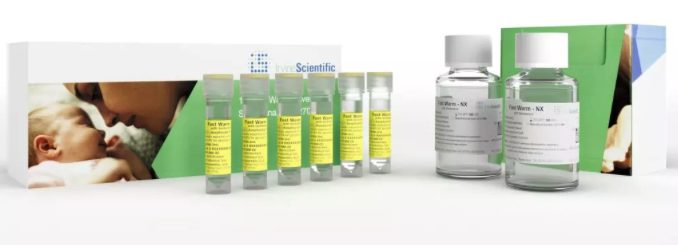
De Gheselle and colleagues ran a three-phase validation at a single university-based IVF center, comparing single-step warming (Vit Kit-Warm NX) against the clinic’s conventional multi-step protocol (Vit Kit-Warm, used through July 2022).
In the preclinical phase, 246 vitrified blastocysts, either donated after the legal storage period or deemed non-transferable following PGT, were warmed with the single-step protocol and compared with 379 historical multi-step controls. Subgroups included non-biopsied Day 5, biopsied Day 5, and biopsied Day 6 blastocysts. A historical non-biopsied Day 6 control was unavailable because the center had not vitrified non-biopsied embryos on Day 6 during the relevant earlier period.
Survival was defined as ≥50% intact cells, full intactness as 100% intact cells, and transfer suitability as ≥50% intact cells at two hours post-warming. Single-step-warmed blastocysts also underwent 24-hour time-lapse observation and live/dead fluorescent staining.
After a successful preclinical phase, the clinic adopted single-step warming for all cycles in March 2024 and ran a retrospective comparison against prior multi-step cycles, tracking total survival (≥50% intact), full survival (100% intact), transfer rate, and pregnancy outcomes (beta-hCG positive, clinical pregnancy, ongoing pregnancy at 10–12 weeks, and miscarriage rate).
What they found
In the preclinical phase, single-step warming outperformed multi-step across every category: 99% survival versus 97%, 85% fully intact immediately post-warm versus 76%, and 97% of blastocysts suitable for transfer versus 91%.
The clinical phase showed the same pattern. Survival and full intactness rates were significantly higher with single-step warming across most subgroups (for example, non-PGT Day 5 survival came in at 98.5% versus 96.1%, and full intactness reached as high as 93.4% versus 77.9% in PGT Day 5 blastocysts). Transfer rates followed suit, significantly higher in three of four subgroups. Ongoing pregnancy rates didn’t differ significantly between protocols in any subgroup, and while a couple of early pregnancy measures favored multi-step warming, miscarriage rates trended lower with single-step warming across all subgroups.
Why it matters
Across both phases, single-step warming improved post-warming blastocyst intactness and transfer-related measures, while ongoing pregnancy rates were comparable to the conventional protocol.
The authors describe single-step warming as a way to reduce procedural complexity and handling time without compromising embryo viability or ongoing pregnancy outcomes for labs looking to streamline cryopreservation workflow.
Want to learn more?
Get the facts on one-step warming →
Sources:
- De Gheselle S, De Vuyst L, Lierman S, De Croo I, Vanden Meerschaut F, Stoop D, Tilleman K. Single-step warming for blastocysts: a clinically validated alternative to conventional multi-step protocols. Hum Reprod. 2026;00(00):1–10. doi:10.1093/humrep/deag021