This year’s ASRM abstracts examine whether the assumed benefits of their cryo-devices, culture media, and transfer media hold up against outcomes data.
The three offer concrete evidence for decisions many labs are already making at the bench.
Hyaluronan-enriched transfer medium: high cost, no implantation gain
A retrospective analysis from Ovation Fertility of 5661 FETs at two centers compared hyaluronan-enriched vs. low lactate transfer medium, with a formal incremental cost-effectiveness ratio (ICER) analysis alongside implantation and β-hCG outcomes.2 Hyaluronan-enriched transfer medium did not significantly improve implantation rates at either site. This medium cost 13 to 16 times more per transfer than low lactate medium.
Key findings:
- Implantation rate: Center 1, 57.7% vs. 56.3% (p=0.29); Center 2, 62.6% vs. 59.8% (p=0.64).
- β-hCG positivity: Center 1 showed a marginal increase, 64.1% vs. 61.6% (p=0.047); Center 2 showed no difference, 70.2% vs. 68.6% (p=0.74).
- Cost per transfer: $46.10-$46.40 (hyaluronan-enriched) vs. $2.90-$3.60 (low lactate), a 13-16x increase.
- Cost per implantation: roughly $74-$80 vs. $5-$6, over 10 times higher. ICER: approximately $1250 (Center 1) and $1360 (Center 2) per additional implantation.
Why it matters: This study tests a common adhesion-based transfer strategy against its price tag, not just its clinical signal. Neither center saw an implantation benefit large enough to justify the added cost.
Cryo-device transition shows no impact on FET outcomes
A single-center retrospective cohort of 292 autologous FET cycles at Illume Fertility found no significant difference in chemical pregnancy, implantation, or clinical pregnancy rates after transitioning from Cryolock to cryo-GO vitrification devices.3 Vitrification and warming protocols were held constant across the transition.
Key findings:
- Chemical pregnancy 79.9% vs. 78.4% (p=0.773)
- Implantation rate 70.1% vs. 69.3% (p=0.903)
- Clinical pregnancy 64.2% vs. 63.6% (p=0.925)
The PGT-tested subgroup showed the same pattern of no significant difference across endpoints.
Why it matters: This study gives labs data-backed support for switching cryo-devices without revalidating clinical performance from scratch, provided the underlying protocol stays the same.
Culture media shows a morphology-versus-euploidy tradeoff
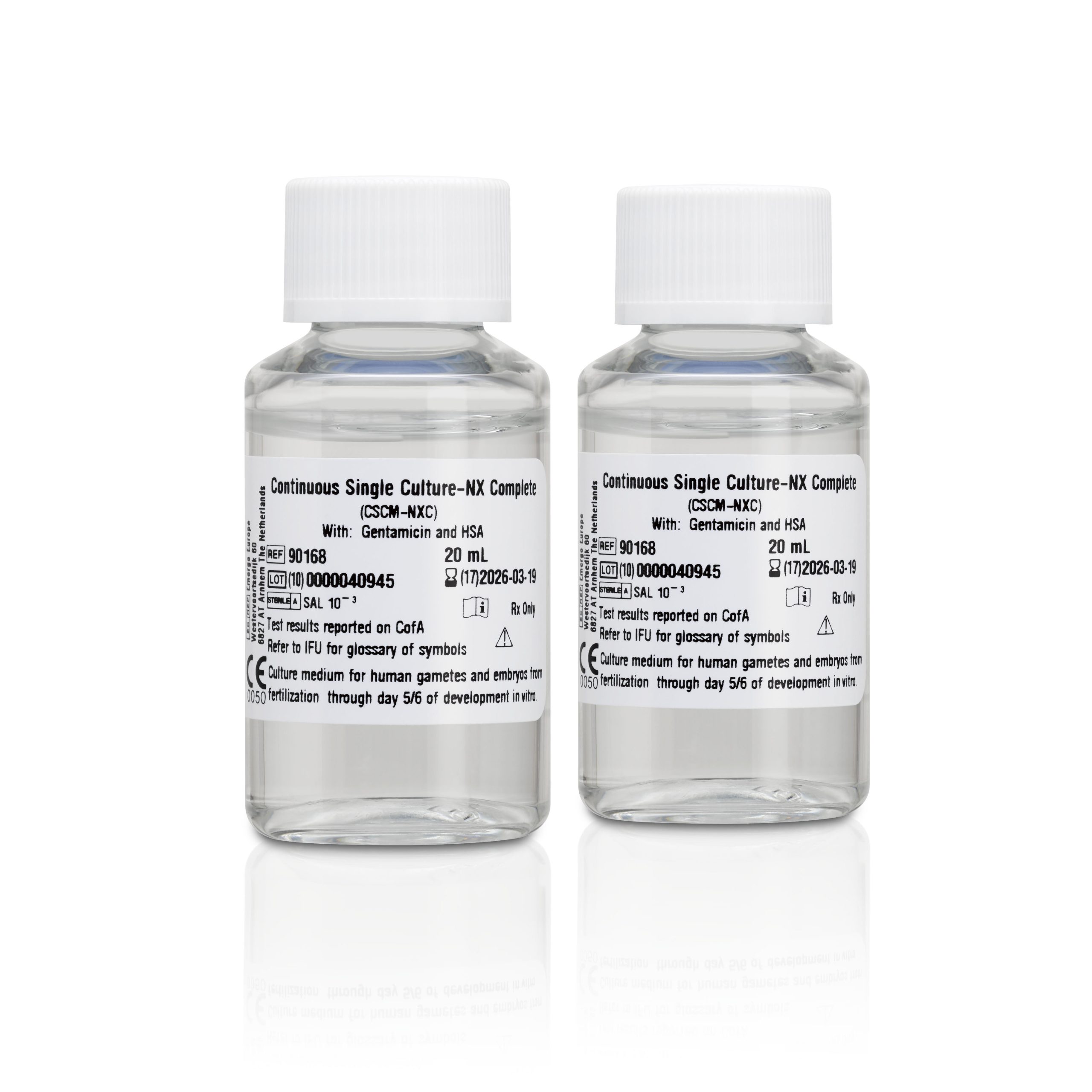
In a study of 65,509 embryos from Shady Grove Fertility, low lactate culture media (CSCM-NX) was associated with a higher likelihood of blastocyst utilization and chromosomal competence than a high lactate system.1 The high lactate system, in turn, produced a slightly higher rate of A-grade morphology.
Key findings:
- Low lactate media showed higher odds of blastocyst utilization: OR 1.06 (95% CI 1.03-1.09, p<0.001).
- The high lactate system showed higher odds of A-grade morphology: OR 1.05 (95% CI 1.01-1.08, p=0.005).
- Low lactate media showed higher odds of chromosomal competence, defined in this study as euploid and mosaic embryos combined versus all aneuploid: OR 1.33 (95% CI 1.27-1.39, p<0.001).
Note that the euploid advantage reflects euploid-plus-mosaic embryos grouped together, not euploid embryos alone.
Why it matters: This is a large enough dataset to take seriously, and it challenges the assumption that morphologic grade and chromosomal competence track together. A lab selecting media based on grading alone may be trading away chromosomal competence it can’t see on the microscope.
Want to learn more?
Get the facts on CSCM-NXC or explore our cryopreservation portfolio.
Sources:
- Applegate CL, Vermilyea L. Culture Media Influences Blastocyst Utilization, Morphologic Grading, And Chromosomal Competence: A Comparative Analysis Of CSCM-NX And 1-Step Systems. Presented at ASRM 2026 Scientific Congress & Expo; October, 2026; Baltimore, MD.
- Singh-Sharma N, Vermilyea L, Vermilyea MT. High Cost Without Clinical Gain: Multicenter Evaluation of Hyaluronan Enriched Transfer Medium Versus Low Lactate Medium for Transfer in Frozen Embryo Transfers. Presented at ASRM 2026 Scientific Congress & Expo; October, 2026; Baltimore, MD.
- Dipietro, EE, Shan C, Vermilyea L. Operational Flexibility Without Clinical Compromise: Equivalent FET Outcomes Following Transition Between Comparable Cryo-Devices. Presented at ASRM 2026 Scientific Congress & Expo; October, 2026; Baltimore, MD.