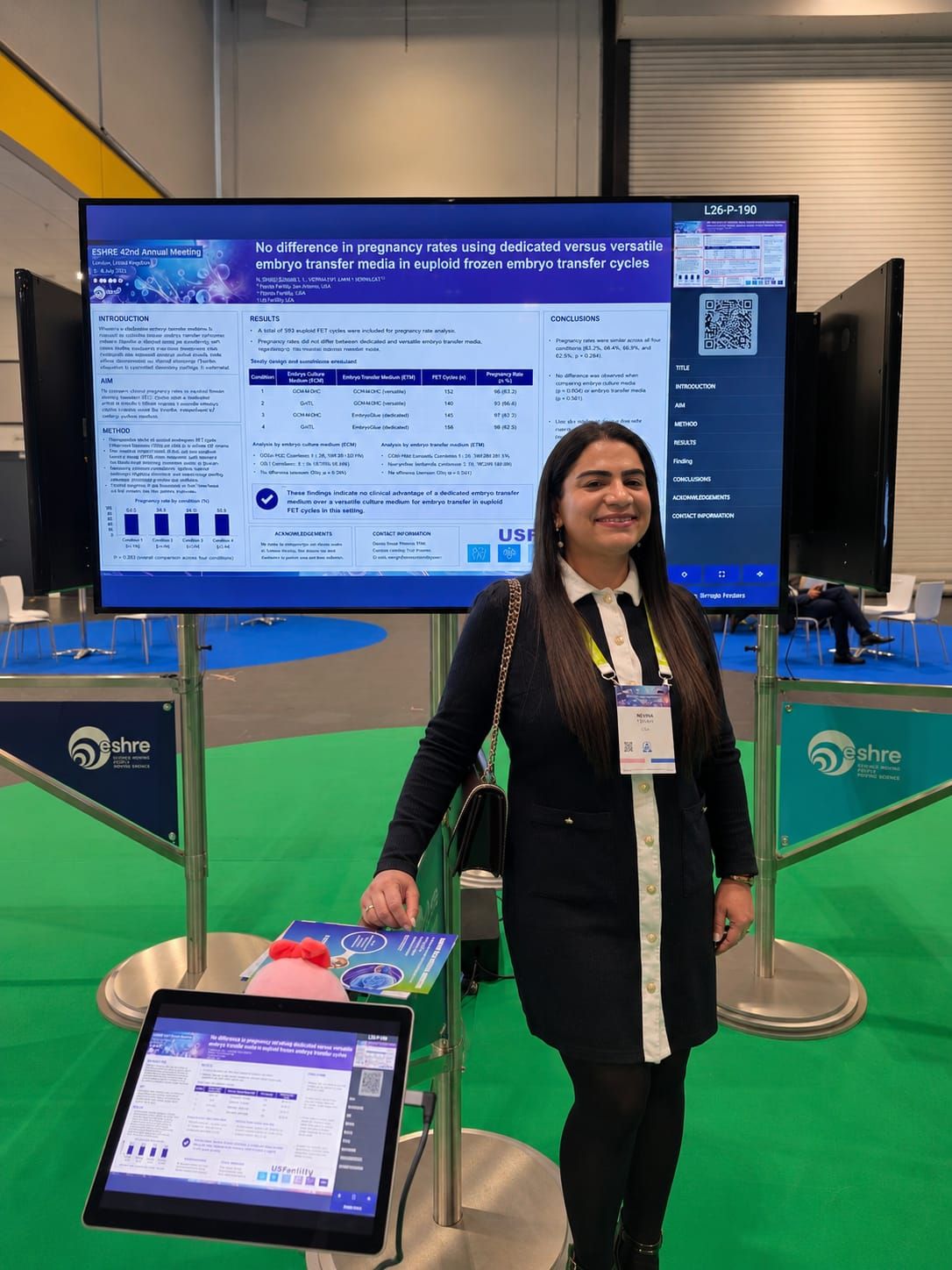
Nirvika Singh Sharma, PhD, associate lab director at Ovation Fertility, presented findings at ESHRE examining whether a dedicated embryo transfer medium is worth its cost premium over a versatile culture medium. She explains why simplifying to a single medium may streamline lab workflow without sacrificing outcomes.
A retrospective review of 593 euploid frozen embryo transfer cycles found no difference in pregnancy rates between a dedicated transfer medium and a versatile culture medium used for transfer, regardless of which culture medium preceded it.
Why it matters: Labs may consider weighing whether a dedicated transfer medium earns its cost. Transfer media typically run more than double the price of a versatile medium, and this analysis found no pregnancy-rate benefit attached to that premium.
The study
- Study design: Retrospective cohort, single private IVF center
- Population: 593 euploid autologous FET cycles (2023–2025)
- Conditions: Four combinations of two embryo culture media (CSCM-NXC, GxTL) and two transfer media (CSCM-NXC as versatile, EmbryoGlue as dedicated); vitrification/warming protocols were held constant across all groups
- Main outcome measure: Clinical pregnancy rate, compared across conditions, by culture medium, and by transfer medium
Key findings
Born from QA, not a hunch. Lead author Nirvika Singh Sharma, PhD, associate lab director at Ovation Fertility, said the project grew out of the center’s own annual outcomes review. “We felt it was important to formally evaluate whether the additional expense translated into improved patient outcomes.”
Year-over-year pregnancy rates in their euploid FET program held steady no matter which transfer medium was used, while the price gap between dedicated and versatile media stayed wide. Combined with growing pressure for cost-effective fertility care, that was enough to justify a formal evaluation.
No clinical advantage with dedicated transfer medium. Pregnancy rates across the four conditions were 63.2%, 66.5%, 67.2%, and 62.5% (p=0.828). Isolating culture medium alone, CSCM-NXC and GxTL produced comparable rates (64.1% vs. 64.5%, p=0.904). Analyzing only the transfer medium, CSCM-NXC and EmbryoGlue performed similarly too (65.1% vs. 62.8%, p=0.561).
“A versatile medium appears sufficient to meet the clinical needs of euploid frozen embryo transfer cycles,” she concluded. “One of its advantages is that it can be used throughout multiple stages of the process, including post-thaw culture, embryo handling, and embryo transfer. This creates a more streamlined workflow and reduces the need for additional media preparations.”
Protocol implications
The real upside may be fewer moving parts. Dr. Sharma flagged reduced procedural error as a potential benefit of consolidating to one medium. A separate transfer medium means a separate dish, separate labeling, one more thing to track.
“Every additional process introduces another opportunity for human error, particularly on high-volume days when multiple transfers are scheduled,” she added.
A simplified workflow with consistency and standardization are solid ingredients for a lab that runs the same way every time, no matter how busy the day gets.
The bottom line
In this cohort, a versatile culture medium did the job of a transfer medium without costing anything on pregnancy rate, and it cut a step out of the workflow doing it. Labs running comparable protocols should ask the same question before paying a premium for a dedicated transfer medium.
Nirvika Singh Sharma, PhD is an associate lab director at Ovation Fertility. Her poster “No difference in pregnancy rates using dedicated versus versatile embryo transfer media in euploid frozen embryo transfer cycles” was delivered at the European Society of Human Reproduction and Embryology 42nd Annual Meeting.
See what a single versatile medium can do for your lab. Learn more about CSCM-NXC here.
Source:
- Singh Sharma N. No difference in pregnancy rates using dedicated versus versatile embryo transfer media in euploid frozen embryo transfer cycles. Presented at the European Society of Human Reproduction and Embryology 42nd Annual Meeting; July, 2026; London, United Kingdom.